AI Interface Design
How AI Improves Collaboration in Prototyping
AI speeds prototyping with real-time co-editing, automated layouts, design-to-code integration, and instant stakeholder feedback.

AI is changing how teams create and refine prototypes by making collaboration faster, smoother, and more interactive. Here's how:
Real-Time Collaboration: Teams work together in shared environments, reducing delays caused by file handoffs.
Automated Tasks: AI handles repetitive work like generating layouts and creating design variations, saving time.
Interactive Prototypes: Tools like Uizard and Framer AI turn ideas into clickable prototypes in minutes, speeding up feedback cycles.
Design-to-Code Integration: Platforms like Builder.io's Fusion connect prototypes directly to production-ready code, ensuring consistency and reducing errors.
Stakeholder Engagement: AI helps generate multiple design options quickly, making it easier for stakeholders to provide meaningful input.
I Put Every AI Prototyping Tool to the Ultimate Test
How AI Enables Real-Time Feedback and Iteration
AI's ability to provide real-time feedback is revolutionizing prototyping by speeding up the refinement process. What once took days of back-and-forth emails and meetings can now happen in minutes, all within shared workspaces. This shift enables teams to collaborate more efficiently and make faster decisions.
Instant Simulation and Design Variants
AI tools like Uizard, Framer AI, and Miro can take text prompts, screenshots, or rough sketches and turn them into interactive prototypes in just minutes. This makes prototyping a dynamic, hands-on process where teams can test multiple design options immediately, instead of spending hours debating theoretical ideas in meetings.
These tools shine when dealing with complex interactions. AI can automatically create connections and basic interactions between screens, transforming static layouts into clickable user journeys with minimal effort. This means teams can explore a wide range of concepts in a matter of hours rather than weeks. AI even generates "what if" scenarios on demand, making it easier to iterate quickly and keep the momentum going.
Keeping Teams Synchronized During Iterations
Modern AI-powered prototyping platforms function like "Google Docs for product design." Designers, developers, and stakeholders can collaborate in real-time, with changes appearing instantly for everyone. If a designer tweaks a layout or a developer adjusts functionality, the updates are visible immediately, eliminating confusion over outdated versions.
But synchronization goes beyond just visuals. Platforms like Builder.io's Fusion integrate directly with GitHub, ensuring that AI-generated changes use actual production components and design tokens rather than placeholders. For example, during Atlassian's "AI Product Builders Week" in November 2025, the team achieved about 70% design system accuracy from screenshots in a single pass. This accuracy improved further with subsequent iterations. By grounding prototypes in real design systems, these tools prevent off-brand variations that often slow down collaboration between design and engineering. What used to take weeks of email discussions can now be resolved in minutes.
How AI Improves Cross-Functional Collaboration
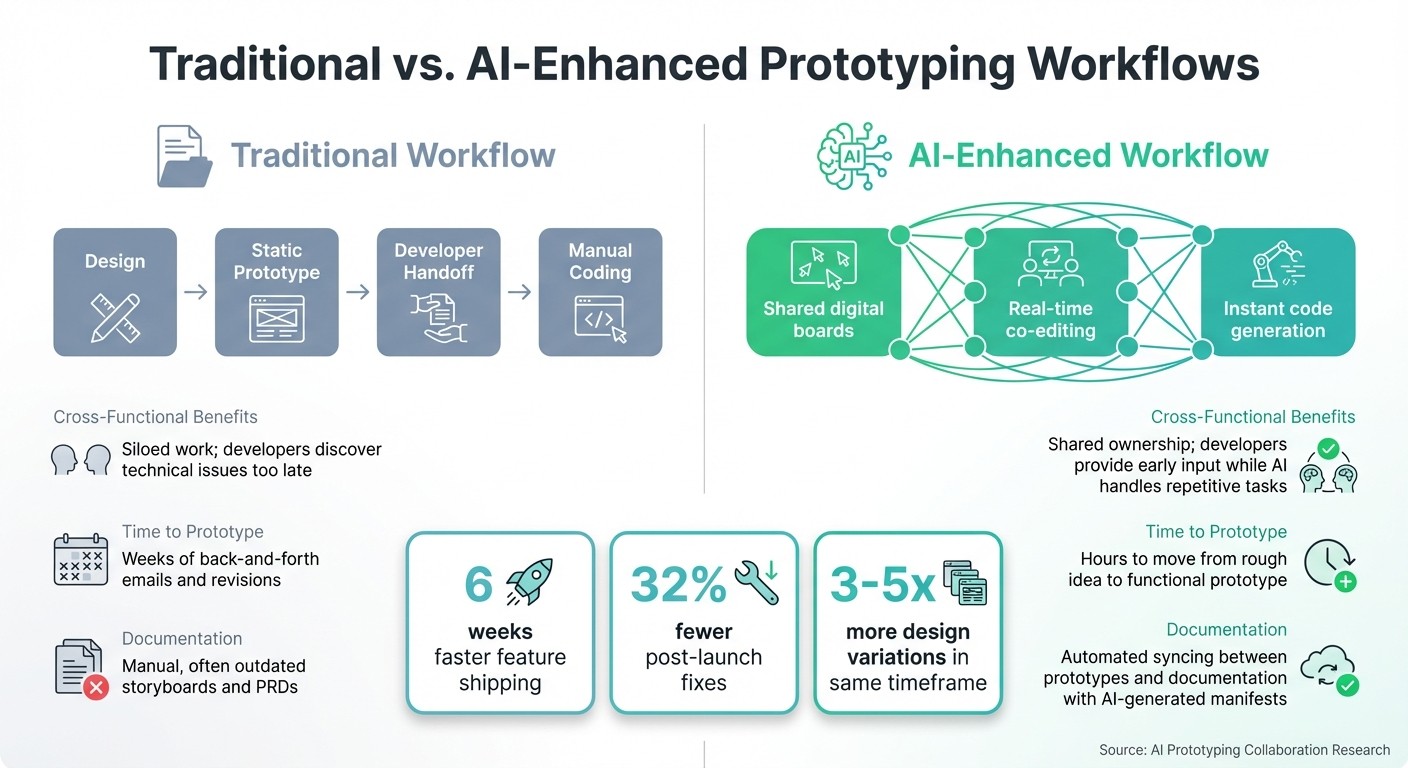
Traditional vs AI-Enhanced Prototyping Workflow Comparison
AI is transforming how design and development teams work together, especially when it comes to bridging gaps in communication and minimizing missteps during project handoffs. Traditionally, when designers hand over mockups to developers, the original vision often gets lost in translation. AI is changing the game by creating shared workspaces where designers and developers can collaborate in real time, using the same tools and frameworks.
AI-Generated Shared Models
AI-powered tools are now capable of producing prototypes that are ready for production, seamlessly connecting design and development efforts. For instance, platforms like Builder.io's Fusion allow designers to create layouts that directly integrate with GitHub, generating pull request-ready components instead of temporary placeholders. This streamlined process has helped teams using collaborative prototyping tools ship features up to six weeks faster, with 32% fewer post-launch fixes compared to traditional workflows.
"With AI prototyping, we turn handoffs into handshakes, enabling true collaboration across crafts."
– Lewis-Ethan Healey, Lead Design Technologist – AI, Atlassian
Traditional vs. AI-Enhanced Collaboration
AI-enhanced workflows bring a level of efficiency and collaboration that traditional methods can’t match. Here’s how they compare:
Feature | Traditional Workflow | AI-Enhanced Workflow |
|---|---|---|
Process Steps | Linear: Design → Static Prototype → Developer Handoff → Manual Coding | Parallel: Shared digital boards, real-time co-editing, and instant code generation |
Cross-Functional Benefits | Siloed work; developers often discover technical issues too late | Shared ownership; developers provide input on constraints early while AI handles repetitive tasks |
Time to Prototype | Weeks of back-and-forth emails and revisions | Hours to move from a rough idea to a functional prototype |
Documentation | Manual, often outdated storyboards and PRDs | Automated syncing between prototypes and documentation, with AI-generated manifests like |
These AI-driven improvements not only speed up workflows but also help teams maintain alignment throughout the project.
Automating Documentation and Alignment
AI doesn’t stop at creating shared models - it also simplifies the tedious task of updating project documentation. By generating automated guidelines, AI ensures that everyone stays aligned on design constraints and component usage. For example, Atlassian has shifted UI decisions to JSON configurations, enabling AI to automatically update specifications while maintaining brand consistency. This frees up designers and developers to focus on solving meaningful problems instead of getting bogged down in documentation upkeep.
"AI reduces inefficiencies and augments people. It takes first passes on ideation, UI comps, and PRDs so teams focus on decisions, not repetition."
– Lewis-Ethan Healey, Lead Design Technologist – AI, Atlassian
"Going from design to code can be a telephone game of unspoken assumptions... AI-powered code generation tools are empowering designers... to explore the key differentiator of their work - the user experience - in high fidelity."
– CJ Gammon, Design Engineering Manager at Adobe
Improving Stakeholder Alignment with AI
AI is reshaping the way teams collaborate during prototyping, making the process more interactive, inclusive, and data-driven. Traditionally, stakeholders have struggled to grasp abstract concepts, often requiring designers to spend significant time explaining ideas that are better experienced firsthand. With AI, this dynamic is shifting, allowing for smoother alignment and more productive discussions.
Rapid Creation of Visual Prototypes
AI tools now enable teams to generate multiple prototype variations in just hours, a process that used to take weeks. This speed allows stakeholders to compare and interact with different designs almost immediately. For instance, platforms like Figma Make let users describe their vision in plain language and create interactive prototypes complete with logic and user flows on the spot. This means teams can see their ideas come to life during the same meeting, keeping the momentum going and facilitating quicker decision-making.
The ability to produce rapid variations also helps avoid the dreaded "design by committee" scenario. Instead of debating over static mockups, stakeholders can engage with tangible options, shifting the conversation to focus on real user experiences. This iterative approach encourages more meaningful discussions and leads to smarter, data-backed adjustments.
Data-Driven Insights for Better Decisions
AI doesn’t just create prototypes - it also analyzes them. By processing stakeholder feedback and usage data, AI can identify patterns and highlight issues that might otherwise go unnoticed. This ensures that decisions are based on objective data rather than subjective opinions or the loudest voices in the room.
Take the example of Jared Stephens, Product Design Lead at TimelyCare. In 2025, he used Lovable to craft a fully interactive prototype aimed at identifying student mental health risks. In just six hours, the prototype was ready and connected to a language model for sentiment analysis, offering stakeholders clear insights into how the feature might perform. Similarly, Claudia Llapart, a Product Manager in the automotive industry, integrated a Datadog snippet into her AI-generated prototype. This allowed her team to track heat maps and click behavior, providing concrete metrics on user navigation within new tabs. These insights fuel ongoing improvements, feeding directly into iterative feedback cycles.
Streamlined Version Tracking and Feedback
AI-powered platforms have revolutionized version tracking and feedback collection. Tools now support branching workflows, letting team members test different ideas without disrupting the main prototype, and then merge successful changes back in seamlessly. Features like visual diffs make it easy to spot what’s been updated, and history tracking allows teams to revert changes instantly when needed.
The feedback process has also become more dynamic. Instead of waiting days for email responses, stakeholders can leave comments directly on specific design elements. AI agents even learn from these interactions, helping to keep everyone aligned.
"I've now started taking screenshots and prompting AI to create a prototype from that. It speeds up the feedback cycle. It also helps me realize how dumb my ideas are before my team has to waste time on them", shared Glen Coates, VP of Product at Shopify.
Real-time iteration has become the norm. Product managers can tweak layouts or text on the fly, ensuring alignment during meetings. This immediacy eliminates the delays that often arise from scheduling follow-up sessions, keeping projects on track and stakeholders engaged.
AI Integration in Design Workflows: The Exalt Studio Approach
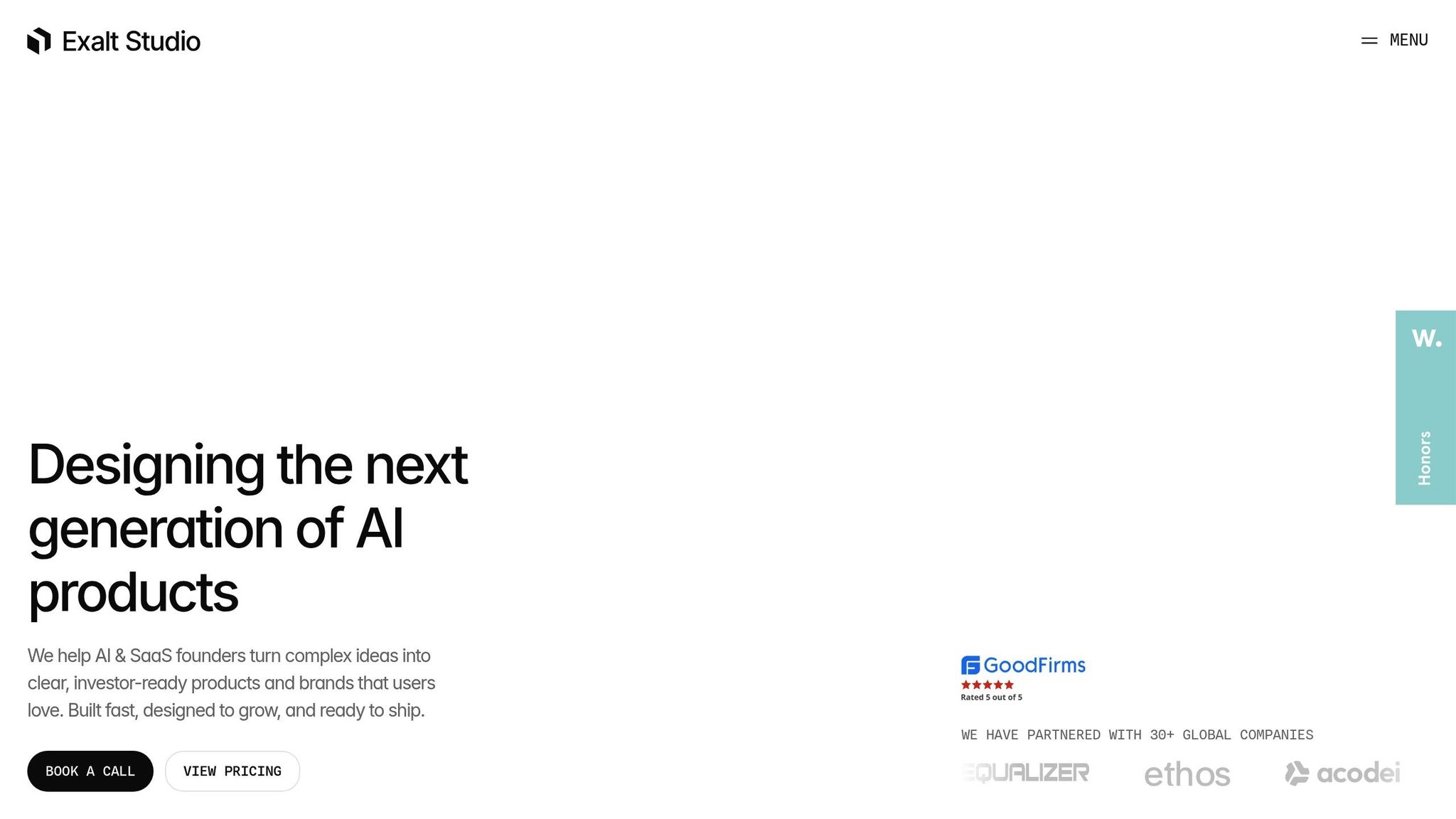
AI in UI/UX Design for Web Apps and MVPs
Exalt Studio leverages AI-powered tools to speed up MVP development for startups in AI, SaaS, and Web3. By using Figma plugins that handle tasks like generating user flows and filling in content, their team can shift focus to the bigger picture - making strategic design decisions instead of getting bogged down in repetitive tasks. This setup enables them to deliver market-ready MVPs in as little as 4-12 weeks.
The studio treats AI as a research assistant, not a replacement for human creativity. Designers rely on AI to quickly create low-fidelity layouts and multiple design variations, then refine and validate these with their expertise. This ensures startups receive prototypes that are both fast and polished. To maintain consistent branding, Exalt Studio uses structured JSON configurations to manage elements like logos and color schemes, minimizing AI-related errors and keeping designs aligned with brand guidelines. This workflow balances creative experimentation with precise execution.
Daily Collaboration Through AI-Enhanced Tools
Exalt Studio keeps collaboration seamless with Slack, enabling real-time communication between designers and clients. This ensures feedback cycles are completed in hours rather than dragging on for days.
For their design retainer service (starting at $4,000/month), the team uses tools like Miro for brainstorming and Figma for reviewing interactive prototypes. AI-powered platforms like UserTesting and Maze analyze stakeholder feedback, identifying trends and providing data-backed insights to guide design decisions. This combination of human input and AI-driven analysis eliminates bottlenecks, streamlining the revision process. These tools also help create scalable strategies, which are crucial for startups preparing for growth.
Scalable Design Solutions for Startups
Exalt Studio develops design systems with standardized components, ensuring smooth collaboration between design and development teams. Thanks to AI automation, these systems make it easier to prototype and roll out new features as products evolve.
For their fixed-project service (starting at $8,000/project), Exalt Studio includes workshops and strategy sessions where AI tools assist in exploring multiple directions before finalizing an approach. By generating rapid prototypes early on, they help startups avoid costly changes later in the process. The studio also considers equity-based partnerships, highlighting its dedication to building sustainable, AI-enhanced collaborations over the long term.
Conclusion
AI has completely reshaped prototyping, turning what used to be a slow and isolated process into a dynamic, real-time collaboration. Designers, developers, and stakeholders can now work together seamlessly, cutting through inefficiencies. Teams adopting these workflows are shipping features 6 weeks faster and dealing with 32% fewer post-launch issues compared to traditional methods. By transforming abstract ideas into interactive prototypes, AI bridges communication gaps and ensures everyone is on the same page.
Instead of static handoffs, AI enables immediate, interactive collaboration. Teams can explore 3–5x more design variations in the same amount of time, catching potential UX problems before they make it into production. Acting like a research assistant, AI generates options and synthesizes feedback, while human expertise ensures the final designs truly connect with users. As Damian Pawłowski, Head of Frontend at Exlabs, aptly puts it:
"The AI we know today is the least advanced it will ever be – every iteration will only make it better".
This shift in collaboration paves the way for tailored solutions, as demonstrated by Exalt Studio's innovative approach.
For startups working on AI, SaaS, or Web3 products, AI-driven prototyping drastically shortens development cycles while preserving quality. By validating ideas in days instead of months, startups can reduce risks and avoid wasting resources. This approach highlights a broader movement toward AI-enhanced workflows across industries.
Exalt Studio harnesses these AI-driven advantages to deliver market-ready MVPs in just 4–12 weeks. Their offerings - retainer services starting at $4,000/month and fixed projects beginning at $8,000/project - combine the speed of automation with the ingenuity of human design. Ready to accelerate your product development? Explore their solutions at https://exalt-studio.com.
FAQs
How does AI enhance real-time collaboration during prototyping?
AI has transformed real-time collaboration in prototyping by making live editing and instant updates a reality. With AI in the mix, designers, developers, and stakeholders can work together effortlessly. Features like automated design suggestions, real-time feedback, and instant UI or code adjustments keep the process smooth and synchronized.
By cutting down on complicated workflows and minimizing delays, AI tools create a more efficient workspace. This gives teams the freedom to concentrate on building prototypes that are both creative and user-friendly.
How does AI improve collaboration in prototyping for design and development teams?
AI-driven shared models simplify teamwork by serving as a central hub for designers, developers, and stakeholders. These models bring together visual designs, interaction details, and code into a single, dynamic workspace. Teams can collaborate in real time, making updates instantly visible to everyone. This approach eliminates the hassle of static file exchanges, endless email chains, and unproductive meetings, streamlining the prototyping process.
By keeping everything in sync, these models ensure design consistency - covering components, colors, spacing, and interaction patterns. This not only speeds up development but also reduces mistakes and allows for quicker iterations. For startups and SaaS products, Exalt Studio leverages AI-powered models to fast-track MVP design, align UI/UX with code, and create smooth digital experiences - all while keeping workflows seamless and efficient.
How does AI enhance collaboration and keep stakeholders aligned during prototyping?
AI transforms collaboration during prototyping into a seamless, interactive experience. It provides a real-time workspace where designers, developers, and stakeholders can work together simultaneously. This setup reduces the chances of miscommunication by offering smart suggestions, automated annotations, and clear summaries of updates. The result? Everyone stays on the same page without relying on endless email chains or back-to-back meetings.
On top of that, AI steps in to flag any potential conflicts with business objectives, suggest data-driven alternatives, and monitor shared KPIs to keep the team aligned with their goals. Features like automated dashboards and real-time sentiment analysis help non-technical stakeholders grasp progress easily and contribute meaningful feedback. By highlighting areas of agreement and addressing misalignments early on, AI speeds up decision-making and ensures smoother teamwork throughout the prototyping journey.