
SaaS User Experience
AI Tools vs. Custom Frameworks for SaaS Design
AI tools speed prototyping; custom frameworks deliver accuracy, control, and long-term ROI—learn when to buy, build, or combine for SaaS.

Which is better for your SaaS product: AI tools or custom frameworks? It depends on your goals, budget, and timeline. AI tools like GPT-4 or Salesforce Einstein are fast to deploy and cost-efficient for standard tasks, while custom frameworks offer more control, precision, and scalability for complex, specialized needs.
Here’s the key takeaway:
AI Tools: Quick setup (2–4 weeks), lower upfront costs ($200–$3,000/month for 1,000 users), but limited customization and higher costs as usage grows.
Custom Frameworks: Longer development time (3–6 months), higher initial costs ($50,000+), but better long-term ROI, accuracy (85–95%), and control over data and features.
Quick Comparison:
Factor | AI Tools (SaaS/API) | Custom Frameworks |
|---|---|---|
Time to Market | 2–4 weeks | 3–6 months |
Upfront Cost | Low ($200–$3,000/month) | High ($50,000–$500,000) |
Customization | Limited | High |
Accuracy | 60–70% | 85–95% |
Monthly Cost | Scales with usage | $3,000–$8,000 maintenance |
Best For | Standard tasks, MVPs | Proprietary, complex needs |
If speed and cost are your priorities, start with AI tools. If your business relies on proprietary features or needs strict compliance, consider custom frameworks. Many companies combine both approaches for the best results.
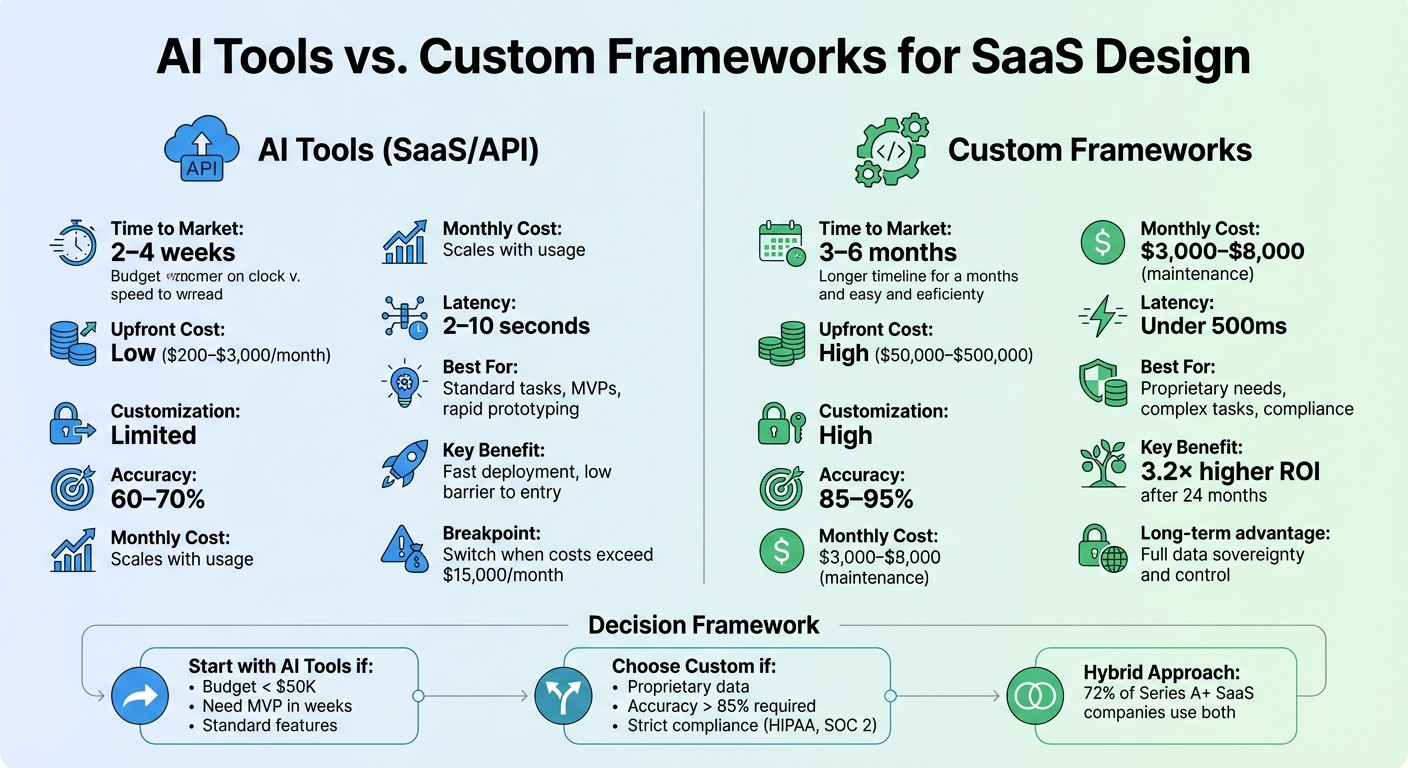
AI Tools vs Custom Frameworks: Cost, Time, and Performance Comparison for SaaS
Can AI Actually Design Real SaaS Products? I Tested 3 Vibe Coding Tools So You Don’t Have To
How AI Tools and Custom Frameworks Differ
AI tools and custom frameworks serve different purposes when implementing AI solutions. AI tools are known for their quick setup and lower initial costs, while custom frameworks take longer to deploy but offer more control over features, adaptability, and long-term expenses.
Deployment Speed and Cost
AI tools excel in speed. You can integrate them within 2–4 weeks, often through subscriptions or API calls, keeping upfront costs minimal. For instance, serving 1,000 users with GPT-4 might cost around $1,000–$3,000 per month, while Claude Sonnet ranges between $200–$800 per month.
On the other hand, custom frameworks demand a more significant initial investment and time. Basic systems take about 3–6 months to deploy, while more complex ones might stretch up to a year. Development costs for these frameworks range from $50,000 to $500,000, covering design, infrastructure, and specialized talent.
However, cost structures evolve as usage scales. While AI tools start with lower costs, they can become expensive with higher usage. Fractional CTO Matthew Turley suggests:
Start with APIs, only build custom when you have no choice.
Companies often switch to custom solutions when API costs exceed $15,000 per month. Despite higher maintenance costs of $3,000–$8,000 per month, custom frameworks eventually offer lower costs per transaction. In fact, businesses using custom AI solutions have reported 3.2 times higher returns compared to those relying on generic SaaS tools after two years. Tools like GitHub Copilot have also reduced development costs by up to 80% and shortened timelines by 50–70%.
Feature | AI Tools (SaaS/API) | Custom Frameworks |
|---|---|---|
Time to Market | 2–4 weeks | 3–6 months |
Upfront Cost | Low/Subscription-based | $50,000–$500,000+ |
Monthly Cost (1,000 users) | $200–$3,000 | $3,000–$8,000 (maintenance) |
Break-even Point | N/A | ~18 months at $15,000/month API spend |
While cost and deployment speed are critical, flexibility is where custom frameworks stand out.
Customization and Flexibility
AI tools prioritize ease of use and speed, but their preset configurations limit deep customization. Users often have to work within the vendor's restrictions and roadmap. For specialized tasks, general-purpose AI tools typically achieve 60–70% accuracy, which may fall short when precision is essential, such as in modeling intricate user behavior.
Custom frameworks, however, allow businesses to create solutions tailored to their specific needs and proprietary data. Take Stripe's Radar fraud detection system, for example - it analyzes patterns across vast amounts of payment data, something off-the-shelf tools simply can't match. Custom models often reach 85–95% accuracy and improve task performance by up to 30%.
Another advantage is speed. While API-based tools may introduce delays of 2–10 seconds, custom frameworks can deliver responses in under 500 milliseconds, significantly enhancing user experience. Additionally, owning the AI logic provides businesses with a competitive edge. As FeatherFlow aptly puts it:
Build what differentiates, buy what does not.
Netflix’s custom recommendation engine is a prime example. By leveraging user-specific viewing data, it has added over $1 billion in value annually by reducing customer churn.
Custom frameworks may take more time and resources upfront, but their flexibility and precision often make them the better choice for businesses looking to scale and differentiate themselves.
Pros and Cons of AI Tools
Benefits of AI Tools
AI tools bring a range of advantages to the table, especially when it comes to speed and accessibility. They allow teams to validate ideas and deploy features about 10 times faster than developing solutions from scratch. This quick turnaround is a game-changer for SaaS teams eager to test concepts and iterate efficiently.
Another major perk is their low barrier to entry, which makes AI tools accessible to startups and non-technical teams. There's no need to hire expensive data scientists or machine learning engineers, whose salaries often range from $169,000 to over $200,000 annually. Instead, subscription-based pricing keeps initial costs manageable, enabling experimentation with user behavior models without committing to the hefty $50,000–$500,000 price tag of custom development. Plus, vendors handle infrastructure, security updates, and model maintenance, reducing operational headaches and allowing teams to focus on building product features.
Drawbacks of AI Tools
Despite their strengths, AI tools have limitations. Customization is restricted, meaning businesses often need to adjust their workflows to fit the tool’s capabilities rather than tailoring solutions to their exact needs. General-purpose models often achieve only 60–70% accuracy for niche or complex tasks, which can be a dealbreaker for industries requiring high precision.
Another challenge is the lack of transparency in how these tools process data. This "black box" nature makes debugging difficult and complicates compliance in regulated sectors like healthcare or finance. Data privacy concerns also loom large, as sensitive information is transmitted through vendor-managed networks and stored in shared environments. For SaaS platforms dealing with financial or health-related data, this can lead to compliance risks with standards like HIPAA, SOC 2, or PCI DSS.
Vendor lock-in poses yet another hurdle. Over half (56%) of AI-focused startups eventually transition from off-the-shelf tools to custom solutions. However, switching isn’t cheap - companies often face 40–60% higher costs than anticipated due to challenges like extracting data and reconfiguring workflows.
Lastly, performance issues can impact user experience. API-based tools sometimes introduce delays of 2–10 seconds, which can frustrate users expecting real-time responsiveness. And as usage grows, costs can skyrocket due to usage-based pricing models, with some companies spending up to $15,000 per month.
Here’s a quick summary of the main pros and cons:
Pros | Cons |
|---|---|
Deploy in 2–4 weeks | Only 60–70% accuracy for specialized tasks |
Low upfront costs ($200–$3,000/month for 1,000 users) | Vendor lock-in with 40–60% higher switching costs |
No need for specialized ML talent | Data privacy risks in shared environments |
Vendor handles maintenance and updates | Limited customization options |
Scales instantly via the cloud | API latency of 2–10 seconds |
Pros and Cons of Custom Frameworks
Benefits of Custom Frameworks
Custom frameworks offer unmatched control over your SaaS design. Unlike pre-built tools, they allow you to tailor software to fit your specific business processes, branding, and operational requirements. This is crucial, as 78% of businesses report that off-the-shelf SaaS solutions fail to meet all their needs.
Custom models also deliver better performance. While generic AI tools typically achieve 60–70% accuracy on specialized tasks, custom models trained on your data can reach 85–95%. Companies using these solutions have reported up to 35% improvements in operational efficiency compared to those relying on generic platforms. Additionally, custom frameworks can meet demanding latency requirements, achieving response times under 500 milliseconds - something general AI APIs struggle to match.
"Custom software built on your unique data creates capabilities that competitors simply can't copy." – Folio3.ai
Another key advantage is data sovereignty. With custom frameworks, you maintain full control over your data, outputs, and algorithms, ensuring compliance with regulations like HIPAA, GDPR, or SOC 2. These frameworks also integrate seamlessly with existing ERP, CRM, and legacy systems, avoiding the middleware headaches that often come with generic AI APIs.
While the initial costs are higher, custom frameworks can save money in the long run. They eliminate recurring subscription fees and the hidden costs of add-ons - expenses that 65% of companies using generic SaaS tools incur. Among SaaS companies that have raised Series A funding or beyond, 72% depend on custom-built software to handle complex business logic.
Drawbacks of Custom Frameworks
Despite their advantages, custom frameworks come with challenges, starting with a hefty upfront investment. Development costs range from $50,000 to over $500,000. Beyond that, hiring specialized talent is essential - machine learning engineers typically earn between $169,000 and $200,000+ annually. Data preparation and acquisition can also account for 15–25% of initial expenses.
Another drawback is the time-to-market. Custom frameworks often take 3 to 6 months to deploy, significantly longer than the hours or days required for off-the-shelf solutions. This delay can slow your ability to validate market demand or introduce new features. In fact, 35% of large enterprise custom software projects are abandoned, with only 29% successfully delivered.
"Start with APIs, only build custom when you have no choice." – Matthew Turley, Fractional CTO
Maintenance is another ongoing burden. It can account for 78–80% of total ownership costs, with annual expenses typically running 15–25% of the initial development budget. Monthly engineering costs can range from $3,000 to $8,000.
Pros | Cons |
|---|---|
85–95% accuracy on specialized tasks | $50,000–$500,000+ upfront cost |
Full data sovereignty and compliance control | 3–6 month deployment time |
35% operational efficiency gains | Requires $169,000–$200,000+ ML engineers |
3.2× higher ROI after 24 months | $3,000–$8,000/month maintenance costs |
Sub‑500 ms latency optimization | 35% of projects abandoned |
Native integration with existing systems | 100% internal maintenance responsibility |
For businesses aiming to deliver distinctive digital experiences, custom frameworks offer unmatched control, performance, and integration. However, the higher upfront costs and ongoing maintenance responsibilities mean careful planning is essential.
How to Choose Between AI Tools and Custom Frameworks
When to Use AI Tools
AI tools are a great choice when speed takes priority over customization. For instance, if you're testing a new product concept, creating a minimum viable product (MVP), or implementing standard features like chatbots or text summarization, off-the-shelf solutions allow you to deliver results in days instead of months. Many businesses use AI APIs early on to gauge demand before investing in custom-built solutions.
"The biggest risk is building something nobody wants. Ship fast with APIs. Optimize later when you have revenue and data." – Matthew Turley, Fractional CTO
These tools are best suited for routine tasks that aren't central to your competitive edge. Examples include customer support automation, basic analytics, or general text processing tasks. They are also cost-effective when budgets are tight or your team lacks the expertise to maintain custom systems. For widely shared challenges like OCR or sentiment analysis, generic tools usually perform well enough.
From a financial perspective, if your monthly API costs stay below $15,000, AI tools provide better returns compared to hiring machine learning engineers, whose annual salaries range between $169,000 and $200,000+. Similarly, organizations with fewer than 50 users or annual license expenses under $50,000 often achieve better value from SaaS subscriptions.
However, if your value proposition depends on proprietary features or ultra-fast performance, a custom framework might be the better route.
When to Use Custom Frameworks
Custom frameworks become essential when your business needs specialized, high-performance capabilities to maintain a competitive advantage. For example, if you're working with proprietary data, require accuracy above 85%, or need response times under 500 milliseconds, generic APIs likely won't meet your needs. This is especially true in industries like healthcare, finance, or legal services, where strict regulations demand secure, on-premise solutions.
Custom development makes sense when you have access to over 100,000 proprietary training examples that can create a competitive edge. For instance, a retail brand developed a custom AI recommendation engine that boosted average order sizes by 26%, outperforming a generic SaaS tool by 11%. Similarly, a logistics company saved $200,000 annually by using a custom AI model for demand forecasting, which helped reduce excess inventory.
A phased approach often works well: "buy to learn, build to last." Start with APIs to test your concept, then transition to custom frameworks once demand is proven and financial conditions support the investment. Research shows that businesses investing in custom AI solutions achieve 3.2 times higher returns than those relying on generic SaaS tools after two years. If vendor limitations are holding you back or your growth depends on leveraging proprietary data, it’s time to consider building a custom solution.
Factor | Choose AI Tools | Choose Custom Frameworks |
|---|---|---|
Business Goal | Rapid prototyping / Efficiency | Competitive advantage / IP creation |
Problem Type | Common (e.g., basic chat, OCR) | Unique / Domain-specific |
Data Type | Public / General data | Proprietary / Sensitive data |
Budget | Limited upfront capital | Available capital for long-term ROI |
Compliance | Standard (GDPR/CCPA) | Strict (HIPAA, SOC 2, FedRAMP) |
Latency | Standard (1–5 seconds) | Extreme (Sub-500ms) |
Conclusion
Success in leveraging AI depends on how well your solutions align with your business model. The key is tailoring your AI strategy to meet your specific needs. Pre-built solutions shine when speed and cost are top priorities, making them perfect for tasks like automating customer support or building early-stage MVPs. On the other hand, custom frameworks are essential when you need proprietary features, top-tier performance, or strict compliance. This ties back to earlier points about balancing cost, speed, and control.
"AI is no longer a nice-to-have. It sits at the center of how companies grow, defend margins, and build an edge." – Ayush Kumar, FeatherFlow
SaaS companies often take a hybrid approach - using off-the-shelf tools for routine tasks while developing custom solutions for core functionalities. For standard tasks, APIs can get the job done quickly. This approach combines the benefits of rapid prototyping with the ability to build a long-term competitive edge.
In fact, 94% of business leaders see AI as critical to their success strategy over the next five years. Companies that align their technology choices effectively can achieve strategic advantages that generic tools alone can’t provide.
Your choice should reflect both where you are now and where you want to go. By finding the right balance between ready-made solutions and tailored innovation, you can set your SaaS product up for immediate impact while paving the way for sustainable growth.
FAQs
What are the key cost differences between using AI tools and custom frameworks for SaaS design?
The cost differences between using AI tools and opting for custom frameworks in SaaS design boil down to three key factors: upfront costs, scalability, and long-term value.
AI tools often come with lower initial expenses. These typically involve subscription or licensing fees and require minimal setup, making them a great option for quick deployment. However, as your usage increases or if you need extensive customization, the costs can add up over time.
On the flip side, custom frameworks demand a larger upfront investment. This includes development, infrastructure, and training costs. But they can pay off in the long run, especially if your business requires tailored features or the ability to scale efficiently. Plus, with recent advancements in AI, building custom solutions has become more accessible and cost-effective for businesses with large-scale or specialized needs.
Ultimately, your decision should align with your SaaS goals, budget, and whether you prioritize flexibility or speed and convenience.
What’s the difference in deployment speed between AI tools and custom frameworks for SaaS design?
Off-the-shelf AI tools are built for speed, often cutting deployment time by 60–70%. This makes them ideal for quickly rolling out features like chatbots or basic analytics without much hassle.
On the other hand, custom frameworks take longer - usually around 4 to 6 months or more. This extra time is spent on tasks like gathering data, training models, and integrating systems. While the process is slower, custom solutions are tailored to fit specific needs, offering better scalability and performance over time.
When should a business switch from AI tools to custom-built frameworks?
When off-the-shelf AI tools start falling short - whether it's due to unique business needs, scaling challenges, or integration headaches - it might be time to think about custom-built frameworks. While pre-made AI solutions are fantastic for quick deployment and experimentation, they often struggle to keep up as businesses grow and face more complex demands.
Some clear signs that a switch is needed include performance bottlenecks, security risks, or the need for tighter control over sensitive or proprietary data. Custom frameworks can address these issues by offering tailored solutions, better scalability, and the flexibility to align with your specific goals. This makes them a smart choice for businesses looking to handle intricate workflows or stay ahead in a competitive market.