
AI Interface Design
Personalized UX for AI-Driven Brands
AI personalization reshapes UX—driving engagement and revenue but demanding transparency, user control, and privacy-first design.

AI-powered personalization is reshaping how brands connect with users. From tailored shopping suggestions to dynamic content recommendations, companies like Amazon, Netflix, and Starbucks are leveraging AI to boost engagement, retention, and revenue. Here’s what you need to know:
Amazon: Processes 150 billion data points daily for real-time recommendations, driving 35% of its e-commerce revenue.
Netflix: 80% of streamed content comes from personalized recommendations, saving $1 billion annually by reducing churn.
Starbucks: Uses AI to customize loyalty rewards and in-store experiences, increasing marketing ROI by 30%.
Exalt Studio: Designs user-focused AI solutions for startups, prioritizing privacy and transparency.
While personalization delivers results - like 40% higher revenue growth - it also raises privacy concerns. Success lies in balancing relevance with user trust. Brands that prioritize transparency and user control can create meaningful, data-driven experiences that resonate with customers.
Case Study AI Driven Personalization in UX Design
1. Amazon's Dynamic Product Recommendations
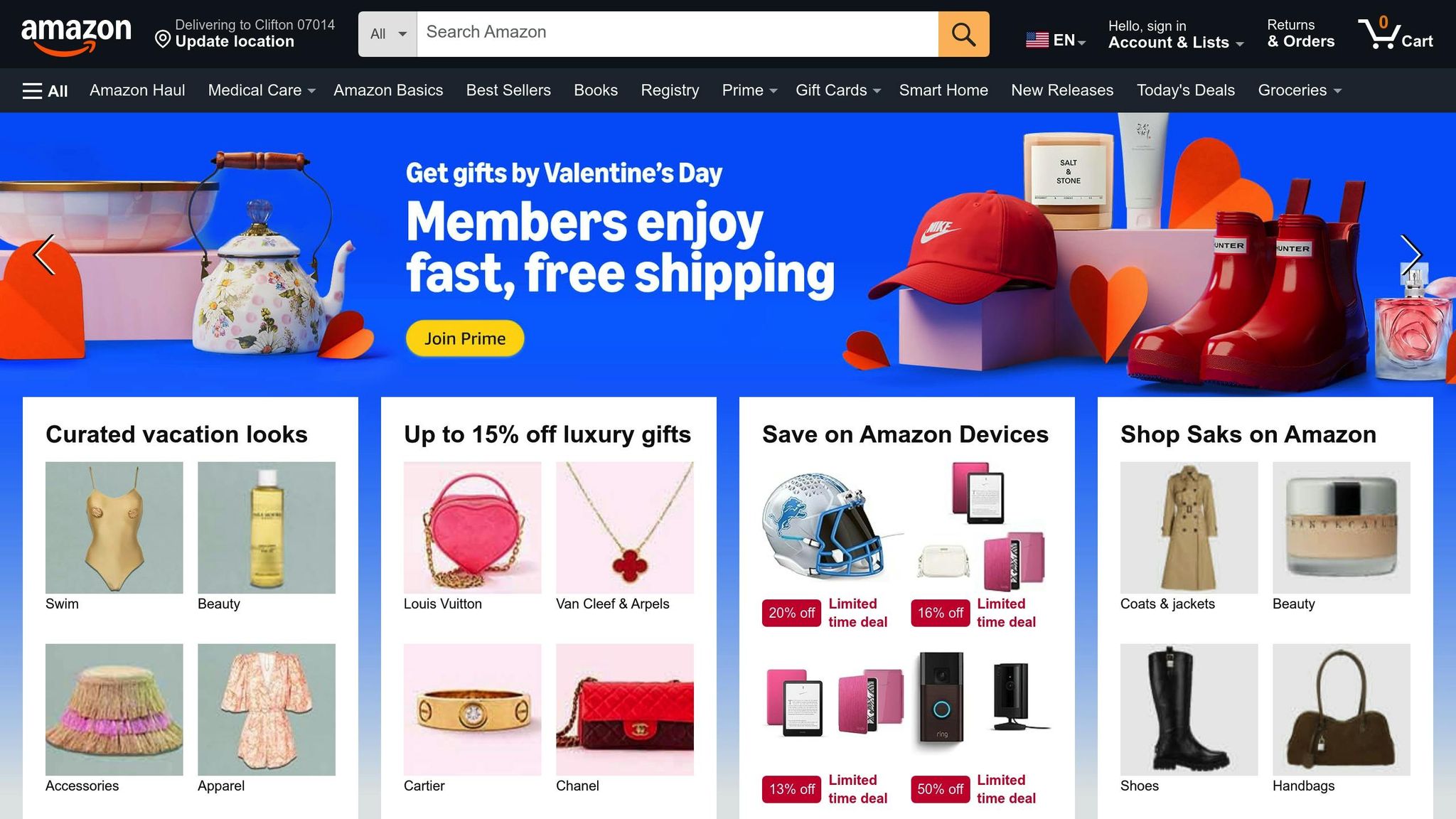
Amazon's recommendation engine is a powerhouse, blending collaborative filtering, deep learning, and generative models. Every day, it processes more than 150 billion data points, analyzing everything from purchase history and search queries to cart activity and even contextual details like the time of day or device type. What makes Amazon truly stand out is its ability to update recommendations in under 100 milliseconds based on user actions like clicks, hovers, and scroll behavior. This real-time adaptability means suggestions can shift mid-session, keeping the experience highly relevant.
In September 2024, Amazon introduced a new generative AI feature through Amazon Bedrock. This feature leverages Large Language Models to dynamically reorder product descriptions, prioritizing details most relevant to individual shoppers. For instance, if a customer frequently searches for gluten-free products, the AI ensures "gluten-free" appears prominently at the start of product titles - even if sellers originally placed it at the end.
Mihir Bhanot, Director of Personalization at Amazon, noted: "If the primary LLM generates a product description that is too generic or fails to highlight key features unique to a specific customer, the evaluator LLM will flag the issue".
These advancements have led to impressive results. Hyper-personalized recommendations achieve 2.3x higher conversion rates compared to generic ones. During the 2023 holiday season, Amazon implemented real-time session modeling that updated cross-category suggestions within seconds. For example, users searching for "noise-canceling headphones" were instantly shown related items like travel cases and audio cables, boosting cross-category conversions by 12%.
Amazon's infrastructure plays a critical role in these outcomes. Powered by GPU-accelerated cloud systems and 25 edge nodes, it maintains response times under 50 milliseconds globally. The system also tackles personalization challenges head-on: content-based filtering addresses the "cold start" problem for new users, while Deep Autoencoders predict preferences even with minimal interaction history. Real-time validation ensures accuracy by filtering out unavailable items.
The impact speaks for itself. Personalized recommendations increase session durations by 47% and page views per session by 31%. Customers receiving tailored suggestions show 26% higher retention rates and a 34% boost in average order value. Amazon's predictive models achieve over 78% accuracy for immediate purchase intent, and recommendation emails see a 29% click-through rate. These stats highlight how Amazon’s cutting-edge AI delivers a shopping experience that keeps customers engaged and drives measurable business growth.
2. Netflix's Personalized Content Engagement

Netflix handles an enormous amount of data - billions of points from over 300 million users. Its recommendation system is a mix of collaborative filtering, which groups users into over 2,000 "taste communities", and content-based filtering, which examines metadata like genre, cast, and themes. At the heart of this is Netflix's Foundation Model, a centralized AI system inspired by large language models. This system learns user preferences across every feature, from "Continue Watching" to "Top Picks", creating a seamless and tailored experience.
This personalization extends beyond just recommending content - it shapes how that content is presented. For example, Netflix uses deep learning to adjust title thumbnails dynamically. For a show like Stranger Things, it may highlight romance for some viewers or supernatural elements for others, increasing engagement by as much as 30%. The platform also monitors micro-behaviors like pausing, rewinding, or hovering over a title. These insights help users find something to watch in under 90 seconds on average, aligning with the "60-90 second rule".
"Consumer research shows a Netflix member typically decides within 60 to 90 seconds after reviewing 10 to 20 titles... The user either finds something of interest or the risk of the user abandoning our service increases substantially", said Carlos Gomez-Uribe, VP of Product Innovation at Netflix.
The results speak for themselves. Over 80% of what users watch comes from personalized recommendations rather than manual searches. This personalization engine also saves Netflix around $1 billion annually by improving retention and reducing churn. The platform boasts a monthly churn rate of just 2.3–2.4%, far below the industry average of 5–7%. Even in content production, Netflix's data-driven strategy shines: its original shows have a 93% success rate, compared to the traditional TV industry's 35%.
Behind the scenes, Netflix relies on AWS to process over 125 million hours of streaming content daily, updating its recommendation models every 24 hours. The system uses a reinforcement learning method called "contextual bandits", which balances confidently recommended content with introducing users to new genres. This approach works across more than 190 countries, tailoring recommendations to fit local tastes and preferences.
3. Starbucks' Deep Brew Loyalty Personalization
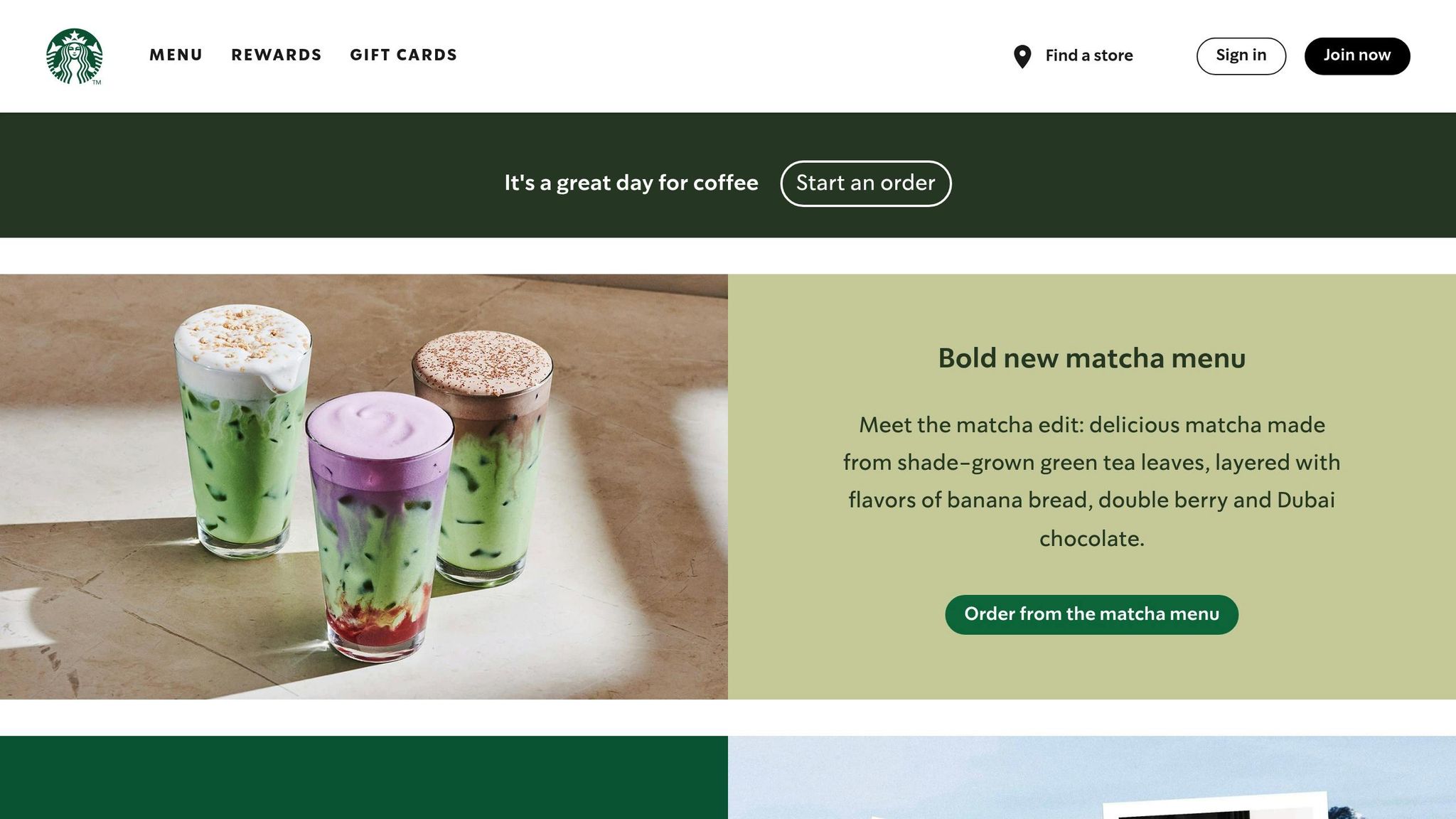
Starbucks has found a way to combine digital technology with its in-store experience, creating a seamless blend of personalization. Drawing inspiration from companies like Amazon and Netflix, Starbucks uses its Deep Brew system to power this integration. Described by CTO Gerri Martin-Flickinger as an "operational nervous system", Deep Brew analyzes factors such as purchase history, time of day, weather, and store inventory to offer tailored recommendations via the mobile app and drive-thru menu boards. By January 2024, the Starbucks Rewards program had grown to 34.3 million active U.S. members - a 13% increase from the previous year - with loyalty members contributing nearly half of the company’s total revenue.
Deep Brew has delivered impressive results, including a 37% increase in repeat purchases and a 30% boost in marketing ROI compared to traditional campaigns. In early 2025, Starbucks introduced "Green Dot Assist", a generative AI tool developed with OpenAI, designed to help baristas with recipe questions and food pairing suggestions. This tool reduced drive-thru service times by 18 seconds per customer - a 14% improvement - allowing two extra cars to be served every half-hour during peak times. It also increased food attachment rates by 7%, generating an estimated $410 million in additional revenue within nine months.
"Our work in AI is providing Starbucks the underlying predictive models, enabling us to fuel the great human reconnection by freeing up partners to do what they do best, connect with customers." – Kevin Johnson, CEO, Starbucks
Deep Brew doesn’t just focus on automation; it also enhances the human touch. For example, inventory tasks that previously took an hour can now be completed in 15 minutes using tablet-based computer vision. This allows baristas to spend more time interacting with customers instead of managing stock. By September 2025, Starbucks had rolled out AI-powered inventory counting across North America. Using 3D spatial intelligence developed with NomadGo, the system scans stock eight times more frequently, significantly reducing shortages of popular items like oat milk and caramel drizzle.
The system's adaptability is another key strength. Deep Brew treats each store as unique, adjusting to local preferences, weather, and community needs. Regional AI customization centers help refine these models for specific markets, such as focusing on tea preferences in Asia or sustainability initiatives in Europe. Built on Microsoft Azure, Deep Brew uses modular designs and federated learning to comply with data privacy laws like GDPR while still delivering personalized experiences. Thanks to these efforts, AI-driven mobile orders now account for over 30% of U.S. transactions, and Starbucks anticipates nearly $3 billion in stored value card prepayments during a single holiday season.
4. Exalt Studio's Approach to AI-Driven UX Design
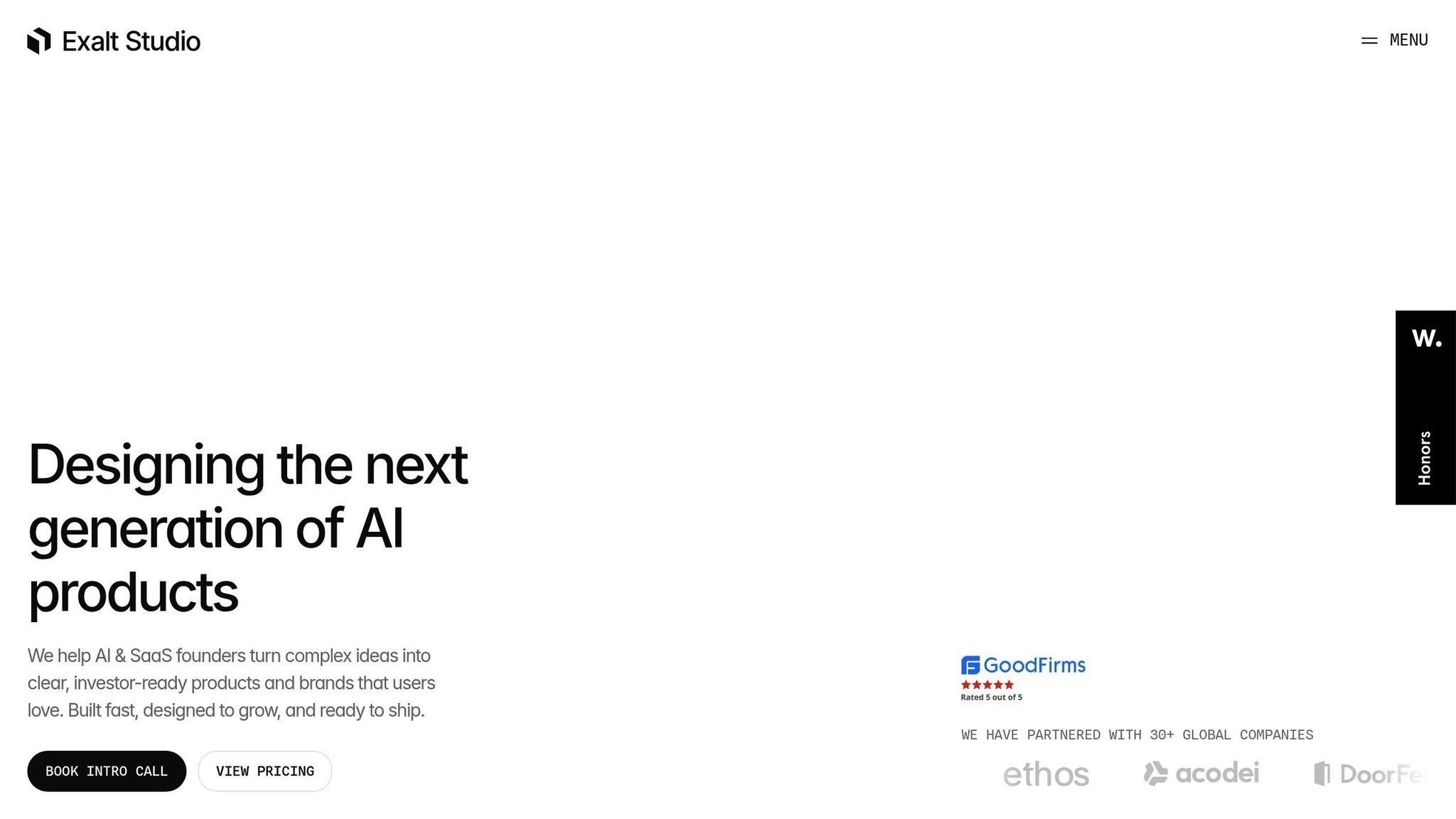
Exalt Studio specializes in crafting AI-driven, personalized user experiences for startups in AI, SaaS, and Web3 industries. Their approach is built around a seven-pattern UX framework that includes features like smart predictions, context-aware customization, and transparent decision displays. These elements work together to boost engagement and create user-centric designs.
At the core of their process is Predictive Design, a methodology that uses AI to forecast user behavior. This approach incorporates tools like adaptive calls-to-action (CTAs), responsive layouts, and behavioral triggers to anticipate user needs. A standout example is Socialsonic, a LinkedIn growth platform designed in just 30 days. Within weeks of launch, it successfully onboarded thousands of users. This predictive approach ensures strategies that are not only scalable but also transparent and user-focused.
To maintain a balance between personalization and transparency, Exalt Studio employs a Layered Transparency Approach for AI decision displays. This system provides different levels of detail - Basic, Intermediate, and Advanced - depending on the user's expertise. This way, users can clearly understand why specific recommendations or content are being presented. Additionally, privacy is a key consideration. The studio incorporates privacy-by-design principles into its UX, offering transparent data usage policies and granular privacy controls.
Scalability is another cornerstone of Exalt Studio's projects. They deliver modular and adaptive frameworks, complete with developer-ready mockups and comprehensive design systems. These frameworks allow interfaces to be easily adjusted or rearranged to suit different user segments or changing behaviors. Their services are primarily aimed at startups, with project pricing starting at $8,000 or retainer models from $4,000 per month. They also offer equity-based deals, aligning their success with the long-term growth of their clients.
Exalt Studio takes their design process a step further by embedding AI into every user interaction. They leverage tools like natural language processing for sentiment analysis and predictive analysis to identify and address potential user friction. This data-driven approach ensures that user needs are anticipated, contributing to their stellar 5.0/5 client satisfaction rating.
Pros and Cons
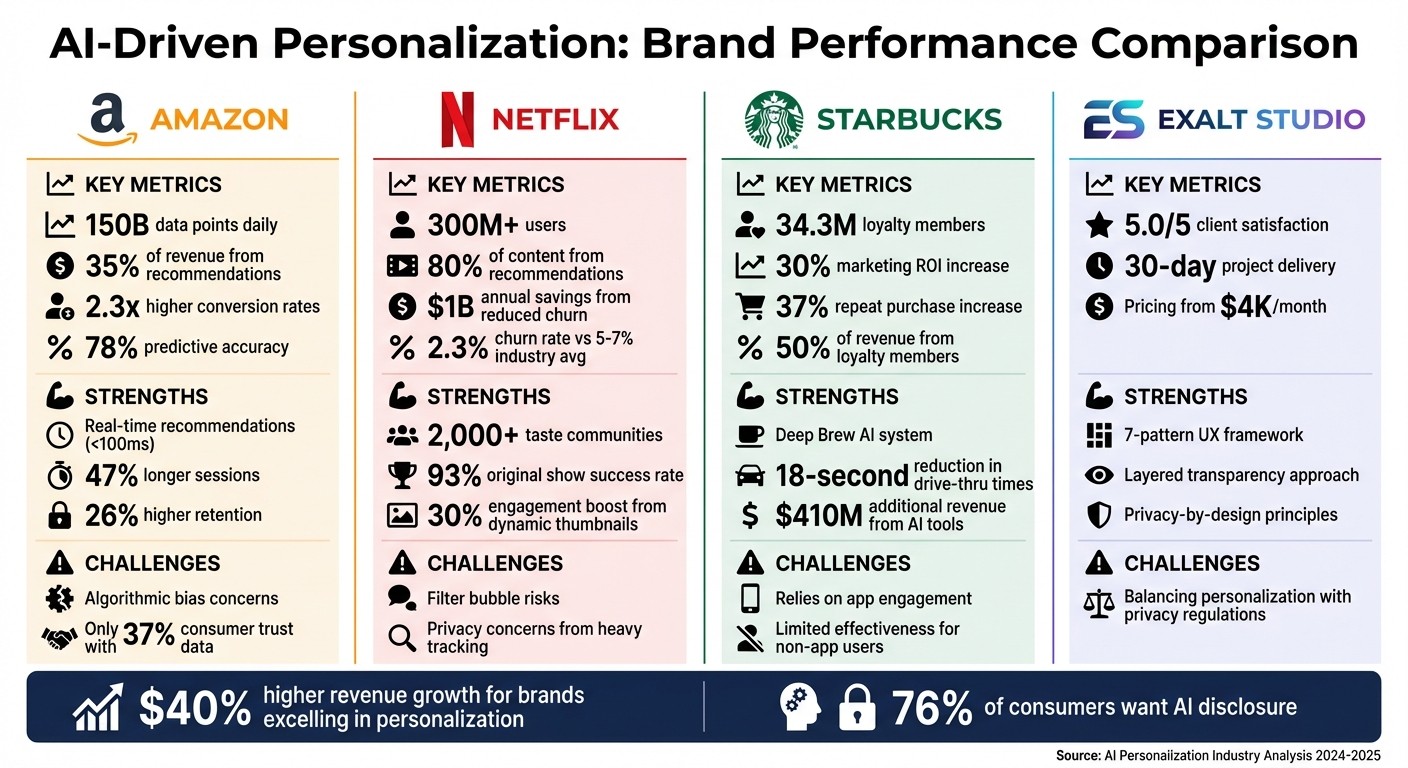
AI Personalization Performance: Amazon, Netflix, Starbucks & Exalt Studio Comparison
Each brand demonstrates distinct strengths and hurdles in how they approach AI-driven personalization. Here's a closer look at how Amazon, Netflix, Starbucks, and Exalt Studio compare in their personalized user experience strategies:
Brand | Strengths | Weaknesses |
|---|---|---|
Amazon | Handles over 150 billion data points daily using item-to-item collaborative filtering, achieving conversion rates 2.3x higher than generic recommendations and 78% predictive accuracy for immediate intent. Its AI recommendation engine drives 35% of total e-commerce revenue. | Struggles with algorithmic bias, such as a hiring tool that discriminated against women. Over-personalization risks feeling invasive, and only 37% of consumers trust companies with their data. |
Netflix | AI recommendations account for over 80% of content streamed, saving the company about $1 billion annually by reducing subscriber churn. Adapts its UI in real time by showing different posters tailored to user preferences. | May create "filter bubbles", limiting content discovery. UI manipulation, like changing posters for the same content, can feel intrusive. Heavy reliance on tracking raises privacy concerns. |
Starbucks | Deep Brew AI leverages data from 30 million loyalty members, boosting marketing ROI by 30% and customer engagement by 15%. Uses contextual triggers like weather and location to make recommendations feel helpful. Successfully connects digital app experiences with physical stores. | Relies heavily on app engagement and push notifications. Effectiveness drops for users who don’t share data or use the app infrequently. |
Exalt Studio | Centers on ethical AI design with a focus on transparency. Offers flexible pricing, starting at $4,000/month for retainers or $8,000/project, with equity-based options available. | Faces challenges in balancing hyper-personalization with strict privacy regulations. |
These comparisons reflect a recurring theme: while personalization can drive impressive results, it often clashes with growing consumer concerns over privacy.
A broader trend also stands out. Consumers increasingly expect tailored experiences but remain wary of how their data is handled. This trust gap forces brands to find a balance between relevance and transparency. Striking this balance can lead to as much as 40% higher revenue growth. Moreover, 76% of consumers believe companies should disclose when AI is part of their interactions.
For brands like Amazon and Netflix, utility and seamlessness often outweigh privacy concerns. Starbucks takes a different route, offering tangible rewards that justify data sharing. Meanwhile, Exalt Studio focuses on transparency, using explainable AI and user-provided data to build trust from the ground up. Managing the "creep factor" effectively remains a key differentiator for all these brands.
Conclusion
AI-powered personalization is reshaping how businesses connect with their audiences. Companies that excel in personalization see 40% higher revenue and 10% stronger growth, yet only 15% of businesses are fully tapping into AI's potential for this purpose. These numbers highlight the critical decisions brands must make, depending on their size and operational model.
For large enterprises, tools like real-time clustering offer a competitive edge. Meanwhile, startups and retail-focused brands can thrive by using modular systems and contextual triggers. Today's AI goes beyond basic preferences - it deciphers intent, emotion, and context in real time to craft experiences that feel personal and meaningful. This approach builds loyalty, with 78% of customers returning to brands that genuinely understand them.
At the heart of successful personalization lies trust. Whether you're Amazon, Netflix, Starbucks, or Exalt Studio, the key is balancing relevance with transparency. Exalt Studio, for example, has embraced transparent design to foster trust and engagement.
"True personalization empowers customers to get what they want - faster, cheaper, and/or more easily".
However, when personalization crosses the line into surveillance or manipulation, even the most advanced AI can't sustain long-term brand value. To build trust, focus on unifying data systems so customers feel recognized across every interaction. Give users control over their preferences, and be upfront about how their data is handled. By prioritizing transparency and user empowerment, brands can create secure, personalized experiences that truly resonate.
FAQs
How do companies like Amazon and Netflix protect user privacy while delivering personalized experiences?
Companies like Amazon and Netflix put a strong emphasis on safeguarding user privacy by embedding privacy by design into their systems. This concept ensures that privacy considerations are integrated at every step, from how data is gathered to how personalized recommendations are delivered.
These companies also prioritize transparency by clearly outlining how they use data and offering users the ability to adjust privacy settings to their preferences. On top of that, they comply with stringent regulatory standards, striking a careful balance between creating personalized experiences and protecting user data. This approach allows them to deliver customized services without compromising the trust of their users.
How does AI help companies like Starbucks improve customer loyalty and engagement?
AI plays a key role in building customer loyalty and boosting engagement by crafting deeply personalized experiences. Take Starbucks, for example - its AI systems dive into data from sources like mobile apps, loyalty programs, and even external factors like the weather. This insight helps them predict what customers might want and when, enabling them to deliver recommendations, promotions, and offers that hit the mark.
These tailored interactions go beyond convenience - they create a sense of connection. Starbucks, for instance, uses AI to analyze individual purchase habits and send offers that feel uniquely designed for each customer. This personalized touch makes people feel appreciated and understood, driving them to return more often and deepening their loyalty to the brand.
How can startups use AI-driven personalization to enhance user experience while building trust?
Startups can make the most of AI-driven personalization by being upfront about how they collect, store, and use user data. Open communication about the benefits of personalization, paired with obtaining clear user consent, goes a long way in building trust. Offering users the choice to opt in or out of personalized experiences further shows respect for their preferences.
To keep that trust intact, companies need to handle data responsibly, follow privacy laws, and clearly explain how AI algorithms influence personalized experiences. By focusing on ethical practices and giving users control, startups can create meaningful, tailored interactions that boost brand loyalty and trust.